Figure 1. Association between the bargain allele of Bicdl1 and thinning of the outer retina identified in a forward genetic screen in mice. Male C57BL/6J mice were mutagenized using
ENU, and induced mutations were transmitted by breeding to third-generation (G3) descendants, which were screened for phenotypes.
OCT imaging was used to screen the G3 mice. A, C: Linkage analyzer software was used to analyze gene-phenotype associations, resulting in Manhattan plots in which the x-axis
represents chromosome numbers, while the y-axis indicates the strength of the association between each mutation (blue dots)
and a given OCT parameter. ORT is shown in (A), TRT is shown in (C). One mutation (in the bargain allele) is significantly associated with thinning in ORT and TRT (p-values = 1.657e−6 and 6.723e−6, respectively). Two horizontal lines are shown: the lower and lighter line represents a p-value of 0.05, while the higher
and darker line shows the threshold of significance after Bonferroni correction. B, D: Analysis of the screening data shows statistically significant thinning in ORT and TRT in only 4 mice, which have Bicdl1 homozygote mutation, suggesting a recessive mode of inheritance. The graphics display the normalized ORT and TRT thicknesses
as means ± SD across different groups of mice at 19-29 weeks of age. WT: wild type (non-mutagenized) mice (B, D; n = 13), REF: mice homozygous for the reference (wild type) sequence of Bicdl1 (B, D; n = 6), HET: mice heterozygous for the Bicdl1 mutation (B, D; n = 15), VAR: mice homozygous for the Bicdl1 mutation (B, D; n = 4). ORT: outer retinal thickness, TRT: total retinal thickness.
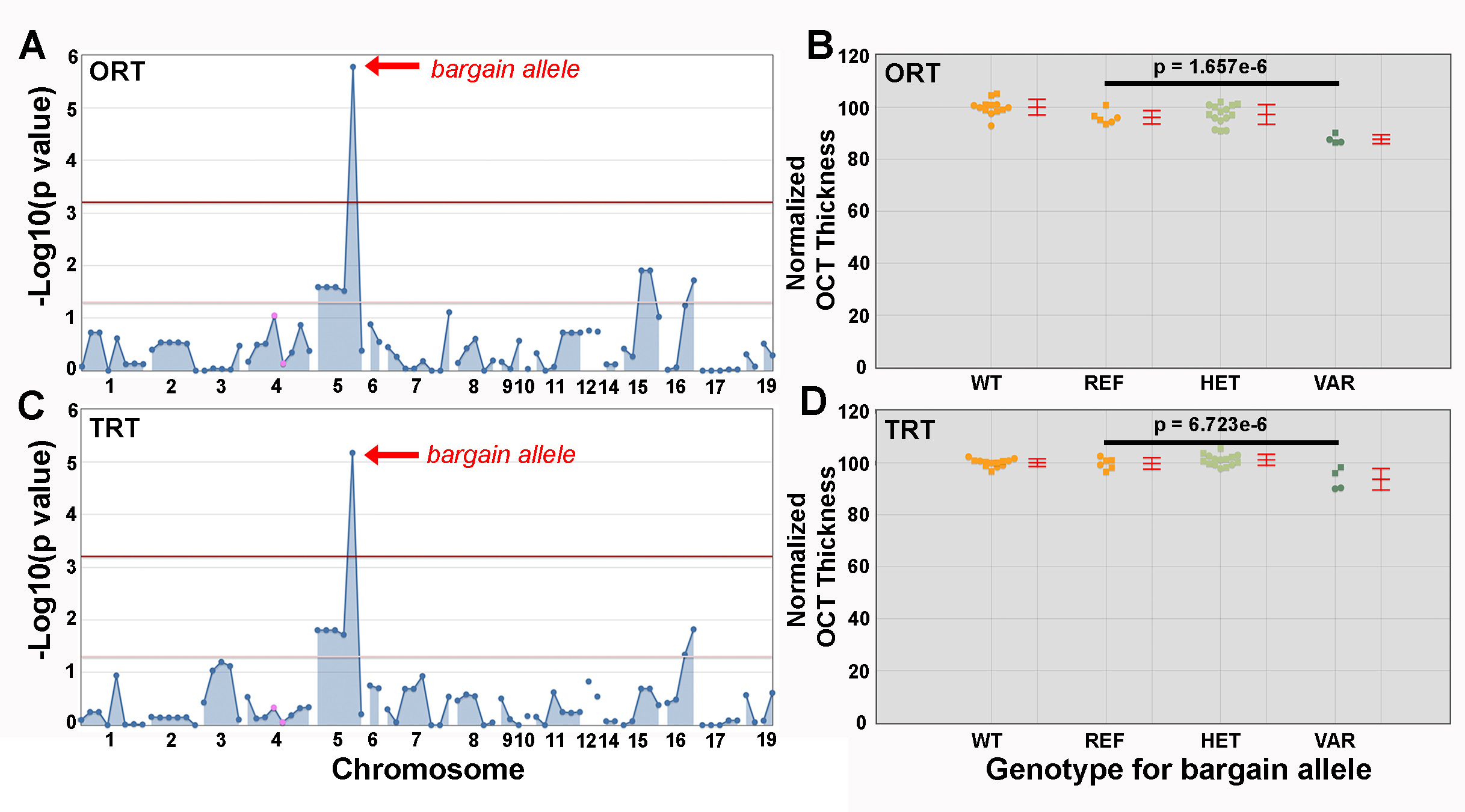
 Figure 1 of
Ulker-Yilmazer, Mol Vis 2026; 32:281-306.
Figure 1 of
Ulker-Yilmazer, Mol Vis 2026; 32:281-306.