Figure 1. Three pedigrees in which novel homozygous pathogenic variants were identified in Usher syndrome-associated genes in this study
along with representative sequence chromatograms. Empty squares and circles indicate unaffected males and females, respectively.
Filled shapes indicate affected individuals. The symbol labeled with a red arrow in each pedigree highlights the proband.
Double lines indicate a consanguineous union. A: Pedigree of the RP057 family showing segregation of the novel PCDH15 splice site variant, i.e., c.877–2A>G in an autosomal recessive manner; (a) shows the sequence chromatogram highlighting
carrier status A/G and (b) shows a homozygous mutant allele G. B: Pedigree of the RP182 family showing segregation of the novel MYO7A single-nucleotide substitution, i.e., c. 470G>A, in an autosomal recessive manner; (c) shows the sequence chromatogram highlighting
wild-type allele G and (d) shows a homozygous mutant allele A. C: Pedigree of the RP220 family showing the segregation of the novel USH2A single-nucleotide substitution, i.e., c. 1143G>C, in an autosomal recessive manner; (e) shows the sequence chromatogram highlighting
carrier status G/C and (f) shows homozygous mutant allele C.
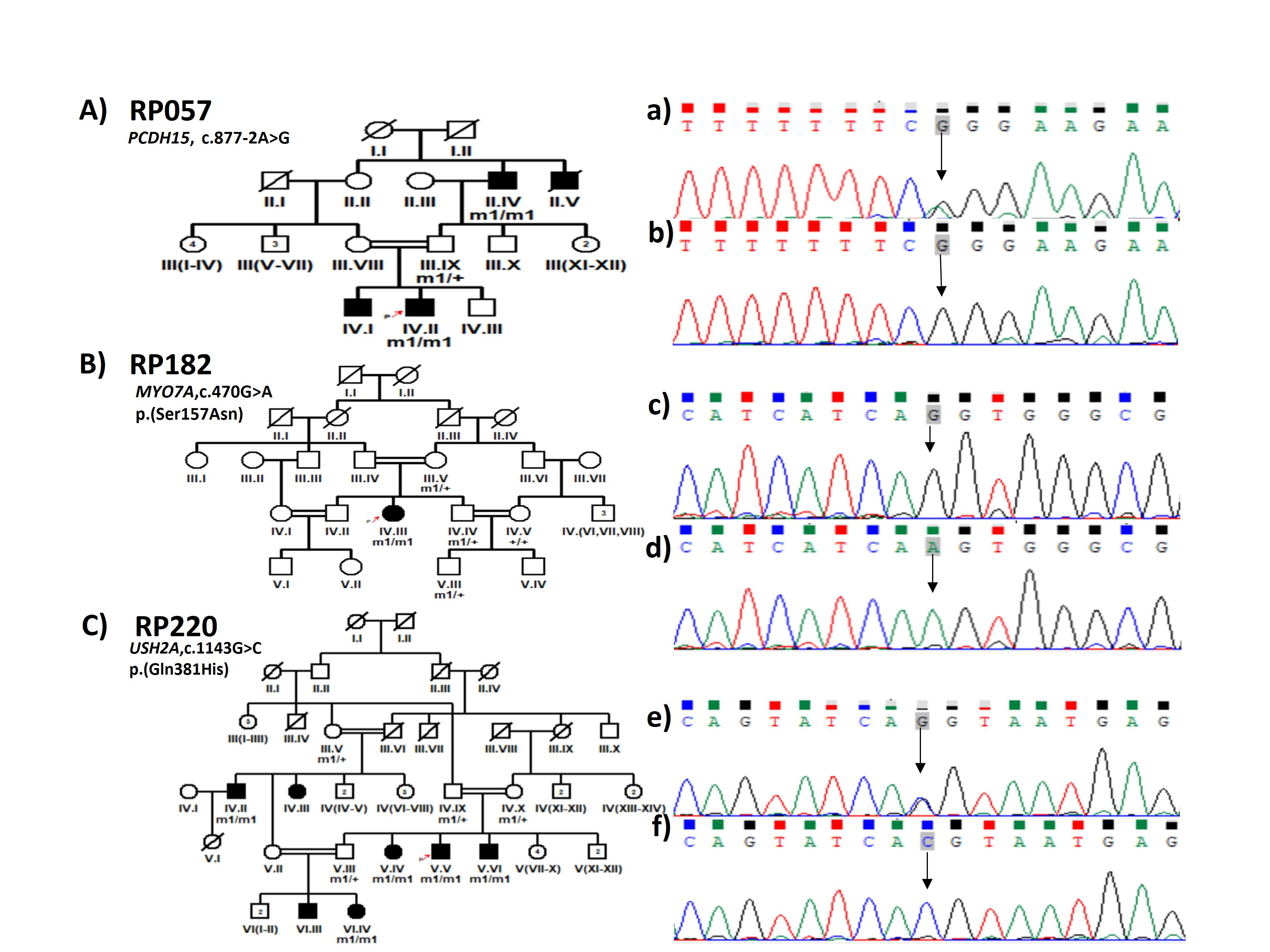
 Figure 1 of
Asghar, Mol Vis 2025; 31:69-83.
Figure 1 of
Asghar, Mol Vis 2025; 31:69-83.