Appendix 1 of
Asghar, Mol Vis 2025; 31:69-83.
Appendix 1 of
Asghar, Mol Vis 2025; 31:69-83. Appendix 1 of
Asghar, Mol Vis 2025; 31:69-83.
Appendix 1. Supplementary Figure 1.
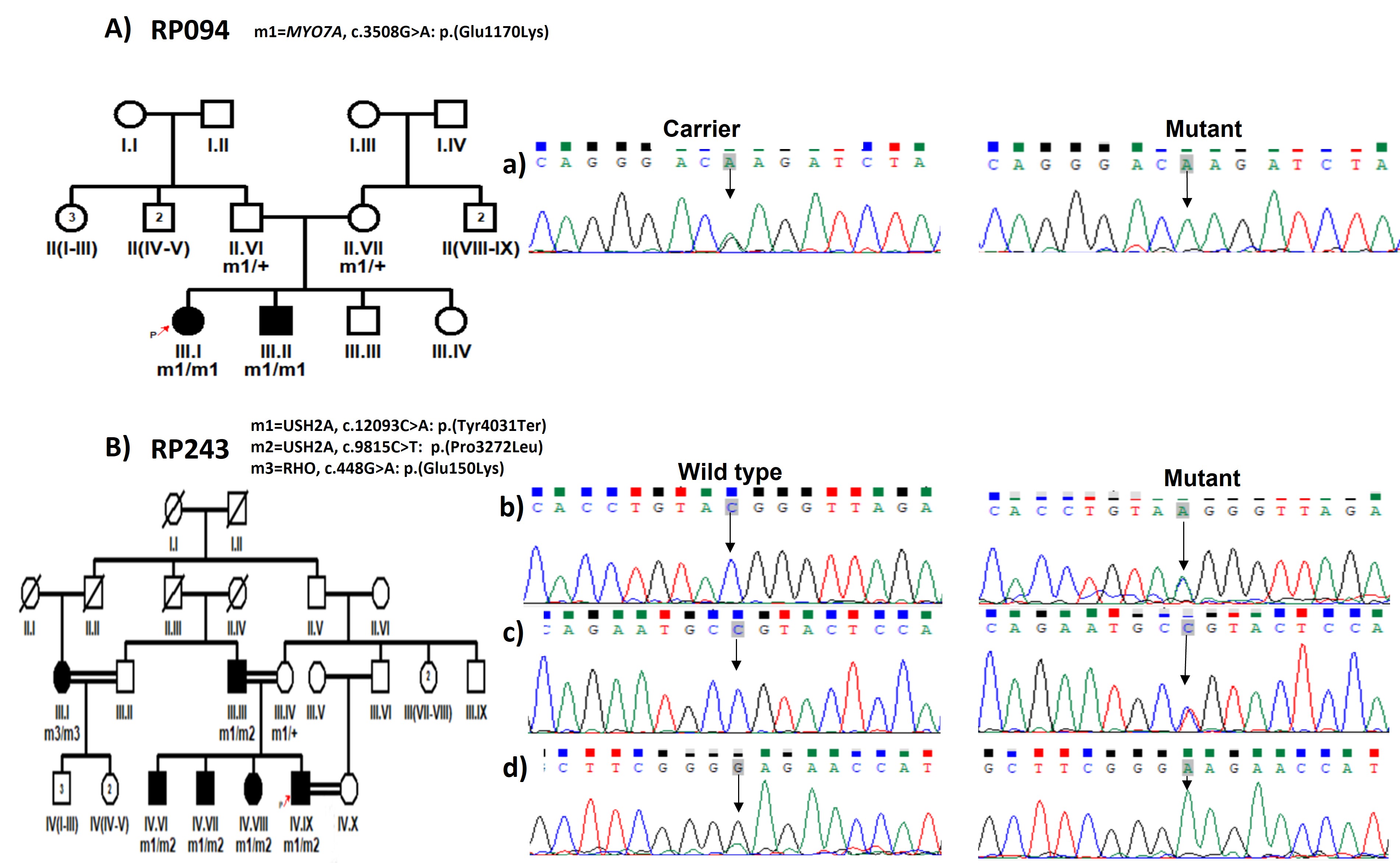
To access the data, click or select the words “Appendix 1.” Two pedigrees in which previously known pathogenic variants were identified in Usher syndrome associated genes in this study along with representative sequence chromatograms. Empty squares and circles show the unaffected males and females, respectively. The filled shapes show the affected individuals. The symbol labeled with a red arrow in each pedigree highlights the proband. Double lines indicate the consanguineous union. A) Pedigree of RP094 family showing the segregation of the MYO7A single nucleotide substitution i.e., c.3508G>A in an autosomal recessive manner however (a) shows the sequence chromatogram highlighting carrier status and a homozygous mutant allele on the right and left side respectively. B) Pedigree of RP243 family showing the segregation of the two heterozygous USH2A single nucleotide substitutions i.e., c. 12093C>A and c.9815C>T in a compound heterozygous manner in five affected cases as well as presence of a homozygous pathogenic RHO substitution c.448G>A in one non-syndromic RP affected individual (III.I) however (b-c) shows the sequence chromatograms highlighting wild-type and heterozygous mutant allele c. 12093C>A and c.9815C>T of USH2A on the right and left side respectively. d) shows the sequence chromatogram highlighting wild-type status and a homozygous mutant allele of RHO i.e., c.448G>A on the right and left side respectively.