Figure 5. MDM-secreted IL-15 promotes the proliferation, migration, and angiogenesis of vascular endothelial cells under HG conditions.
The experiment was divided into five groups: control group (Con), endothelial cells cocultured with THP-1 (MDM) group, endothelial
cells cocultured with HG-stimulated THP-1 (HG MDM) group, endothelial cells cocultured with HG-stimulated THP-1 with IL-15
knockout (HG MDM–IL-15 KO) group, and endothelial cells treated with HG and cocultured with HG-stimulated THP-1 (HG + HG MDM)
group. Vascular endothelial cells and THP-1 were stimulated with HG solutions (25 nM glucose), and the IL-15 gene was knocked
out in THP-1 treated with HG. The two types of cells were then cocultured. A. The CCK8 assay was used to detect the cell proliferation rate of vascular endothelial cells cultured for 0, 12, 24, and
48 h. B. EdU staining was used to assess cell proliferation ability. C. The cell wound-healing assay was used to detect cell migration ability. D. The angiogenesis assay was used to detect tubule formation ability. E,F. Western blot was used to detect the protein expression levels of p-STAT1, STAT1, p-STAT5, STAT5, and EFNA1. *p < 0.05, **p < 0.01, ***p < 0.001. n = 3. Statistical significance was determined by using an unpaired Student t test for two groups or one-way analysis of variance for more than two groups. Subsequently, Dunnett’s post hoc tests were
conducted. p < 0.05 was considered significant.
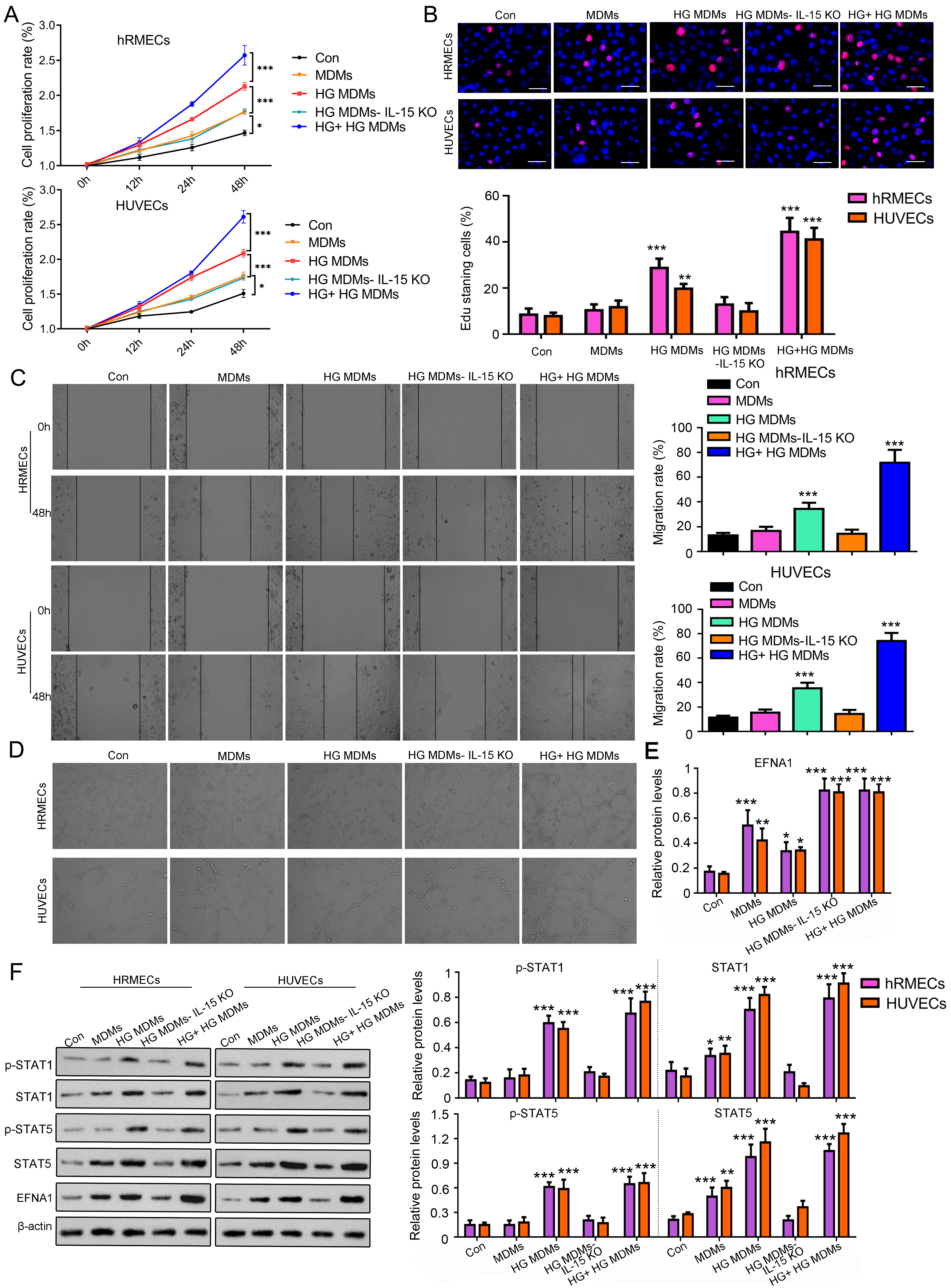
 Figure 5 of
Zhang, Mol Vis 2025; 31:597-616.
Figure 5 of
Zhang, Mol Vis 2025; 31:597-616.