Figure 4. Phase-contrast micrograph of formazan crystals that were developed in cells (Passage 4), which had been cultured on A/G substrate
and polystyrene, the bar graph of 3-(4,5-dimethylthiazol-2-yl)-2,5-diphenyltetrazolium bromide (MTT) assay, and the effect
of A/G substrate on cell proliferation and apoptosis. Mitochondrial dehydrogenase enzyme in living cells reduces MTT to soluble
purple formazan crystals. The absorbance of the samples was quantified by spectrophotometer. A: Representative formazan crystals in amniotic fluid (AF), fetal bovine serum (FBS), and Dulbecco’s modified Eagle’s medium/nutrient
mixture F-12 (DMEM/F12)-treated hRPE cells on polystyrene and A/G substrate. B: The results of the MTT cell viability assay. The viability of hRPE cells on A/G substrate and polystyrene were nearly the
same in HAF (p = 0.04), FBS (p = 0.11), and DMEM/F12 (p = 0.8). C and D: The effect of A/G substrate on cell proliferation and apoptosis, respectively. The 4th passage hRPE cells (104 cells/well)
were seeded in 96-well plates, on A/G substrate and uncoated polystyrene, in 3 different aforesaid conditions. 48 h later,
cell proliferation and cell death were assessed using ELISA kits. Cell proliferation was increased on A/G substrate when compared
to polystyrene in HAF (p = 0.0009), FBS (p = 0.002), and DMEM/F12 (p = 0.008) treatments. (*p<0.05) Each bar represents means
± standard error of the mean (SEM) of at least three independent experiments performed in triplicate. Magnification: 200X.
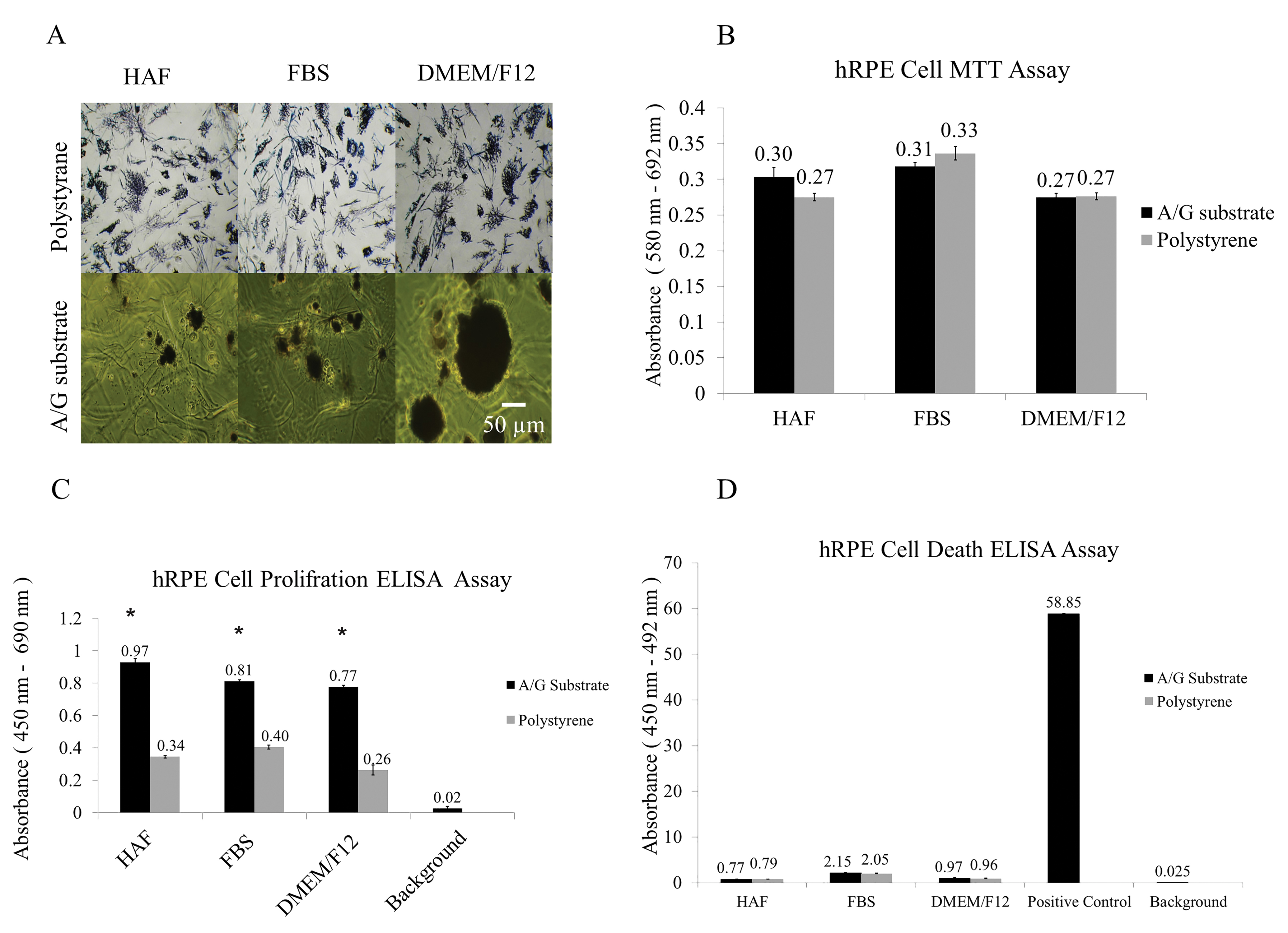
 Figure 4 of
Shamsnajafabadi, Mol Vis 2022; 28:412-431.
Figure 4 of
Shamsnajafabadi, Mol Vis 2022; 28:412-431.